

Helicopter Blade Lift for the U.S. Navy, Corpus Christi
-
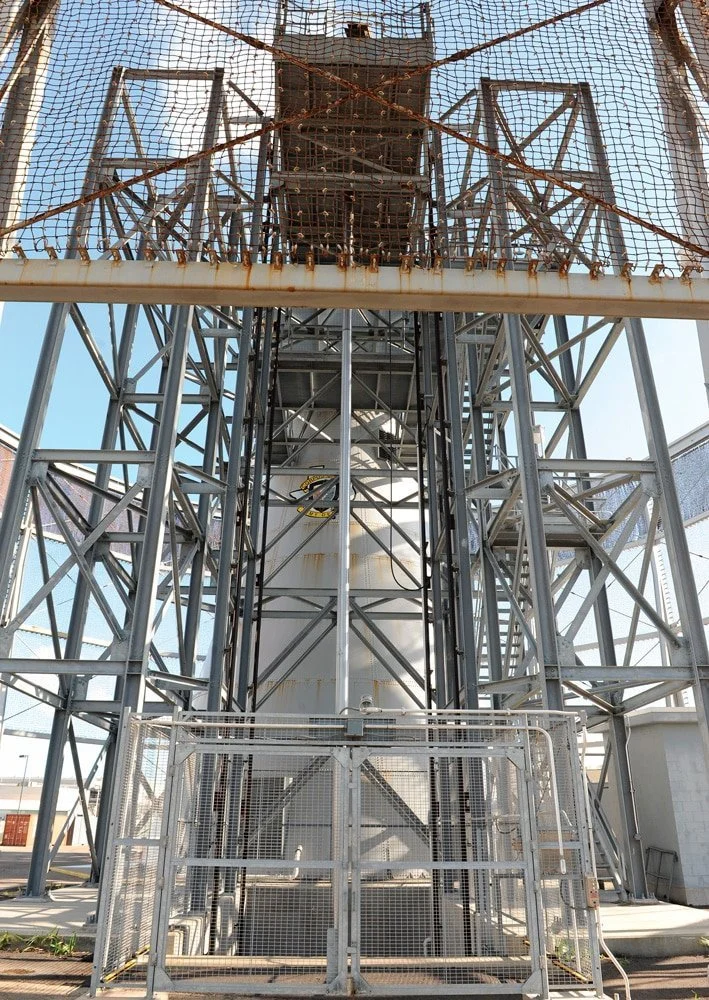
At a U.S. Navy facility in Corpus Christi, Texas, helicopter blades are spin balanced at the top of a 60-foot structural steel tower after being mounted to a spin shaft fixture. For years the existing conveyor system used to transport blades to the top had been plagued by breakdowns, causing significant downtime and lost productivity. The culprit was twofold: an overly complex system made worse by rust and corrosion from the salty Gulf air. Maintenance had become the primary activity rather than blade balancing. Beyond simply replacing the lift, the project presented an additional complication. Helicopter blades sag before reaching operational speed, meaning fixed handrails on the upper work platform would interfere with blade rotation during balancing. For years, workers had been manually installing and removing those handrails while working at height, a hazardous process requiring safety harnesses.
-
Gillespie's approach was to radically simplify. Rather than replicate the complexity of the failed system, Gillespie designed a straightforward hydraulic platform lift, 12 by 26 feet, with a 5,000-pound capacity traveling 58 feet and 9 inches at 50 feet per minute, powered by a single in-ground cylinder with a 50-horsepower submerged pump. Blades are transported throughout the facility on a purpose-built cart, which rides the platform lift to the top of the tower. For the handrail problem, Gillespie replaced the dangerous manual process with eight powered retractable handrail sections on the upper work platform, each operated by compressed air cylinders already available in the tower. The lift includes an intermediate landing position below the upper work platform, allowing it to clear the handrail plane during blade balancing. Interlocks prevent the spin balance from operating unless both the lift and handrails are confirmed in their lowered positions. To combat the corrosive environment, all structural steel was sandblasted and coated with cold galvanizing compound, and the sliding portions of the powered handrails were fabricated from stainless steel tubing.
-
A dramatically simplified system replaced years of costly breakdowns, returning the focus at the facility to what it was always meant to be: balancing helicopter blades, not repairing equipment. For Gillespie, it was another example of solving a problem others had struggled with by stripping complexity away rather than adding to it.
John Linsley, Gene Richards and Gary West documented this project in a feature article published in Elevator World magazine. To read the full article, click here.
Challenging project?
Contact us at sales@gillespiecorp.com, call 413-967-4980 or visit www.gillespiecorp.com.